


Page 64 - 《橡塑技术与装备》2023年11期
P. 64
橡塑技术与装备                                          CHINA RUBBER/PLASTICS  TECHNOLOGY  AND EQUIPMENT

                                                                 表 3 不同 PVC/NCC 复合材料的综合力学性能数据
                                                                          拉伸强度 缺口冲击强度 /      弯曲模量 /   断裂伸长
                                                                 实验对象                   -2
                                                                           /MPa     kJ . m     MPa     率 /%
                                                                PVC/NCC-1   31.4     18.7      3 314    78
                                                                PVC/NCC-2   33.2     23.4      3 375    93
                                                                PVC/NCC-3   35.7     30.9      3 401    117
                                                                   同理,PVC/NCC-2 和 PVC/NCC-3 冲击强度的
                                                               提高,主要也是因为 NCC-2 和 NCC-3 能够在 PVC
                                                               基材中形成连续的填料相,可以更有效的传递界面应
                                                               力和引发微裂纹 ;而 NCC-1 由于粒子改性效果不佳,

                  图 4  不同 PVC/NCC 复合材料的 TG 曲线图                 在 PVC 基材中容易形成团聚,形成应力集中点,导致
                                                               力学性能较差。
             2.4  流变性能分析
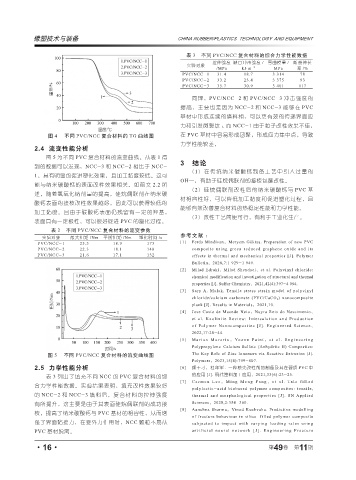
                 图 5 为不同 PVC 复合材料的流变曲线。从表 1 得
                                                               3 结论
             到的数据可以发现,NCC-3 和 NCC-2 相比于 NCC-
                                                                  (1)在传统纳米碳酸钙制备工艺中引入过量的
             1,具有明显的促进塑化效果,且加工黏度较低。这可
                                                               OH—,有助于硅烷偶联剂的接枝包覆改性。
             能与纳米碳酸钙的表面改性效果相关。如前文 2.2 所
                                                                  (2)硅烷偶联剂改性后的纳米碳酸钙与 PVC 基
             述,随着氢氧化钠剂量的提高,硅烷偶联剂在纳米碳
                                                               材相容性好,可以降低加工黏度和促进塑化过程,且
             酸钙表面的接枝改性效果越好,因此可以获得较低的
                                                               能够有效改善复合材料的热稳定性能和力学性能。
             加工黏度。且由于碳酸钙表面仍残留有一定的羟基,
                                                                  (3)改性工艺简便可行,有利于工业化生产。
             表面具有一定极性,可以很好促进 PVC 的塑化过程。
                   表 2 不同 PVC/NCC 复合材料的流变参数
               实验对象      最大扭矩 /Nm    平衡扭矩 /Nm    塑化时间 /s       参考文献 :
              PVC/NCC-1      25.5       18.9        173        [1]   Ferda Mindivan,Meryem  Göktaş.  Preparation  of  new  PVC
              PVC/NCC-2      22.3       18.1        148            composite using green reduced graphene oxide and its
              PVC/NCC-3      21.6       17.1        132            effects in thermal and mechanical properties [J]. Polymer
                                                                   Bulletin,2020,7:1 929-1 949.
                                                               [2]   Milad Edraki,Milad Sheydaei,et al. Polyvinyl chloride:
                                                                   chemical modification and investigation of structural and thermal
                                                                   properties [J]. Sulfur Chemistry,2021,42(4):397-4 094.
                                                               [3]   Sary A. Malak.  Tensile stress strain model of polyvinyl
                                                                   chloride/calcium carbonate (PVC/CaCO 3 ) nanocomposite
                                                                   plank [J]. Results in Materials,2021,10.
                                                               [4]   Jose Costa  de Macedo  Neto,Nayra  Reis  do Nascimento,
                                                                   et al. Kaolinite Review: Intercalation and Production
                                                                   of Polymer Nanocomposites [J]. Engineered Science,
                                                                   2022,17:28-44.
                                                               [5]   Ma r i us Mu ra ri u , Yo a n n  Pa i n t , e t  a l .  E ng i n e e r i n g
                                                                   Polypropylene–Calcium Sulfate (Anhydrite II) Composites:
                 图 5    不同 PVC/NCC 复合材料的流变曲线图                      The Key Role of Zinc Ionomers via Reactive Extrusion [J].
                                                                   Polymers,2023,15(4):799-807.
             2.5  力学性能分析                                       [6]   颜干才,杜年军 .  一种核壳改性剂的制备及其在硬质 PVC 中
                                                                   的应用 [J]. 现代塑料加工应用,2021,33(6):23-25.
                 表 3 列出了填充不同 NCC 的 PVC 复合材料的综
                                                               [7]   Ca rme n Le e , Mi ng Me ng Pang , et  a l.  Ta lc  fi ll ed
             合力学性能数据。实验结果表明,填充改性效果较好
                                                                   polylactic-acid biobased polymer composites: tensile,
             的 NCC-2 和 NCC-3 填料后,复合材料的拉伸强度                         thermal and morphological properties [J]. SN  Applied
             有所提升,这主要是由于其表面硅烷偶联剂的成功接                               Sciences,2020,2:354-360.
                                                               [8]   Aanchna  Sharma,Vinod  Kushvaha.  Predictive  modelling
             枝,提高了纳米碳酸钙与 PVC 基材的相容性,从而增
                                                                   of fracture behaviour in silica-filled polymer composite
             强了界面黏接力,在受外力作用时,NCC 颗粒不易从                             subjected  to  impact  with  varying loading  rates  using
             PVC 基材脱离。                                             artificial neural network [J]. Engineering Fracture

             ·16·                                                                            第 49 卷  第  11 期

